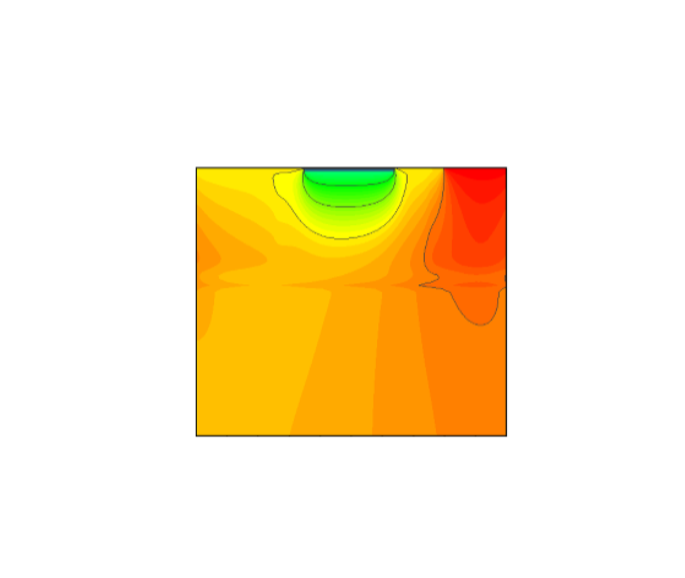
Monte Carlo particle simulator solves Boltzmann transport equation (BTE) with inclusion of various non-linear scattering mechanisms through Monte Caro (MC) technique on few valleys or full band structure. The dynamics of Monte Carlo particles, also known as superparticles under influence of applied external field are solve self-consistently through the solution of decoupled Poisson's and BTE equation over a suitably small time-step. The time step is taken typically less than the inverse plasma frequency obtained with the highest carrier density in the device. Poisson’s equation solution is generated over the mesh node points over the full range of space coordinates in accordance with the particle distribution itself. Particle-mesh (PM) coupling scheme is used for assignment of carrier charge on different nodes and for calculation force on each charges.
The solution of self-consistent Boltzmann-quantum-Poisson equations is carried out by selecting proper device geometry and doping density in 2D and 3D over TNL-PD simulator through GUI enabled feature. Users may use input physical parameters from bydefault, from III-V and II-VI (binary & ternary) semiconductor materials database and also have flexibility to define their own input parameters. The various carrier scattering mechanisms use to calibrate the real device transfer characteristics output. The density of states (DOS) in each valley are accurately inputted through full band structure.The quantum effect can be included through density gradient, Bohm quantum potential and effective potential approaches to handle carrier confinement. Particle Device Simulator (PDS) is use to simulate unipolar as well as bipolar devices including MOSFET, dualgate, multigate FETS, Nanowires, Nanosheets, HEMT, P-N junction and other compound semiconductor devices.
Nano-objects are emerging from bottom-up nanotechnology as well as in ultra-scaled top-down nano-transistors, a new physics including quantum features has emerged and cannot be properly captured by the conventional models of device physics.
TNL-Nano device simulator is based on Wigner-Boltzmann formulation with scattering effects to the study of quantum transport problems in some typical nanodevices for the analysis of decoherence and tunneling effects with use of any quantum model. .